


Description
Wiebe Knobbe (Heerenveen 1934 – Groningen 1989) draw his inspiration mainly from prehistory and ancient cultures. By varying methods he presents this ancient world in different ways. Now his images are reminiscent of old parchments, then again of old crumbling walls and occasionally of strange signs. He works on panel with relief and by giving a cut in cardboard he knows how to achieve the atmosphere of the old worlds in beautiful brown colours.
After this ‘historical’ phase in his work, he became well-known in Friesland after the exhibition that Thom Mercuur organized in Museum ‘t Coopmanshûs in 1977. His small watercolors of softly flowing colors evoke associations with misty landscapes and high, thin skies. Like Willem van Althuis and Sjoerd de Vries, he was also receptive to the influence of the landscape northwest of Heerenveen, in which the colors gray, green and blue determine the atmosphere. With minimal means, often just a single horizontal stripe, he manages to create space and light in his work. In the work from the 1980s, simple, watercolored lines appear in that space, reminiscent of houses and urban contours. He called them ‘wanderings’. Paper, line, light and color form an inseparable unity in his world of thought. Wiebe felt connected to Sjoerd de Vries and Willem van Althuis. He corresponded with the latter regularly. ‘Willem does in oil paint what I do in watercolour’, he once said. This kindred spirit translates into the same kind of stillness and modesty in their work. Museum Belvédere in Oranjwoud has a good representation of this ‘landscape’ phase in its collection.
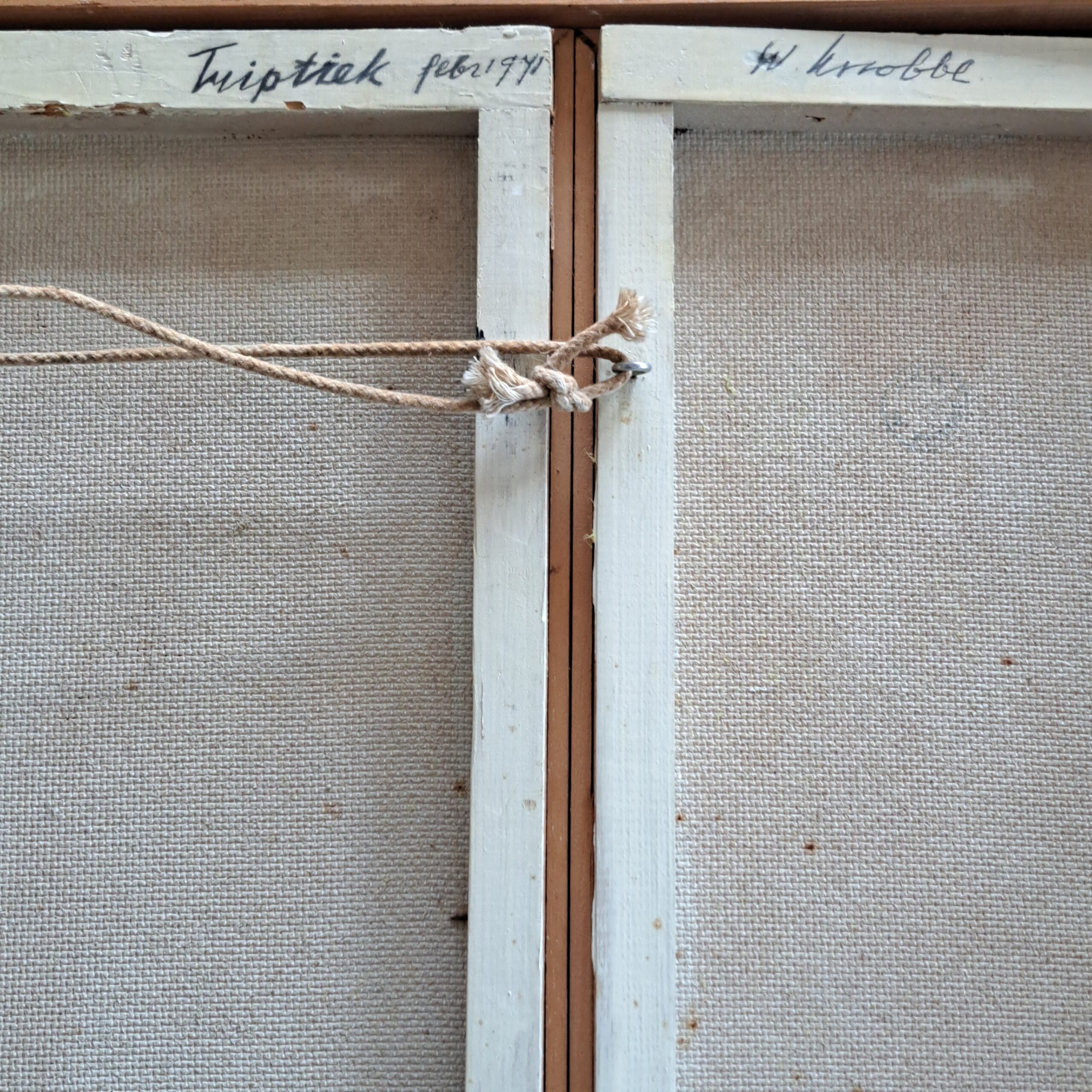
So this very rare work by Knobbe represents the ‘historical’ phase in a magnificent way. It is really the atposphere of a long fergotten and lost civilisation, The work is in mixed media on board, in very good condition, 69x50x4, signed and dated on the back ‘triptiek febr 1971 wiebe knobbe’


